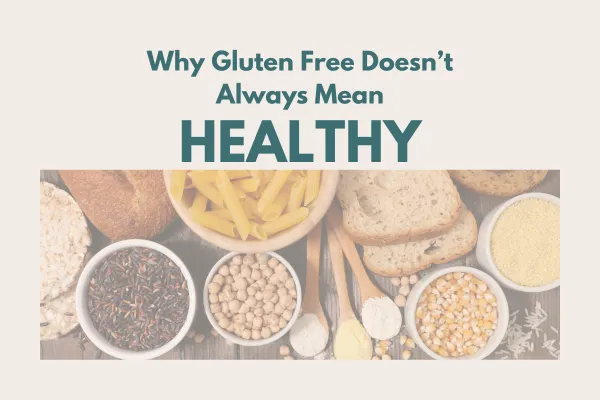
Why Gluten-Free Doesn't Automatically Mean "Healthy"
Why Gluten-Free Doesn’t Automatically Mean Healthy
“Gluten-free” has become one of those labels that instantly signals health in people’s minds. It sits in the same category as “organic,” “natural,” or “clean”—words that feel reassuring, even if we don’t fully understand what they mean in practice.
And because of that, it’s easy to assume that choosing gluten-free foods is a step in the right direction.
But here’s the reality: gluten-free doesn’t actually tell you much about the quality of a food—or how it’s going to impact your body.
To understand why, we need to take a step back and look at what gluten actually is, who truly needs to avoid it, and what happens when it’s removed from food.
Gluten is a protein found in wheat, barley, and rye. For individuals with Celiac disease or true gluten sensitivity, avoiding gluten is essential. In the case of Celiac disease, even small amounts can trigger an immune response that damages the small intestine and interferes with nutrient absorption.
For those individuals, going gluten-free isn’t a trend—it’s a medical necessity. And when done correctly, it can be life-changing.
But for the majority of people, gluten itself isn’t inherently harmful. The issue isn’t the presence of gluten—it’s the overall quality and composition of the foods we’re eating.
And that’s where things start to get a little misleading.
What Happens When Gluten Is Removed?
When food manufacturers remove gluten from a product, they don’t just leave an empty space behind. Gluten plays a key role in texture, structure, and elasticity—especially in things like bread, pasta, and baked goods.
So when it’s taken out, it has to be replaced with something else.
Most often, that “something” includes refined starches like rice flour, potato starch, tapioca starch, or corn-based ingredients. These are used to recreate the soft, chewy texture that gluten would normally provide.
On top of that, manufacturers often add extra sugar, salt, and processed oils to improve flavor and mouthfeel.
The end result?
Many gluten-free packaged foods are:
Lower in fiber
Lower in protein
Higher in rapidly digestible carbohydrates
More likely to cause blood sugar spikes and crashes
Less satiating, leading to increased hunger shortly after eating
So while the label might suggest a “healthier” option, the nutritional profile often tells a very different story.
In some cases, a gluten-free version of a food is actually less nutritious than its regular counterpart.
The Power of the “Health Halo”
Part of what drives the popularity of gluten-free products is something known as the “health halo” effect.
When a food carries a label that sounds healthy—like gluten-free, organic, or low-fat—we tend to automatically assign it a higher nutritional value. We assume it’s better for us, even without looking at the ingredient list.
That assumption changes behavior.
People are more likely to:
Eat larger portions
Snack more frequently
Overlook added sugars and processed ingredients
Feel less urgency to balance their meals
It creates a false sense of security.
A gluten-free cookie still contains sugar, refined carbohydrates, and calories. A gluten-free muffin still behaves like a muffin in your body.
The label doesn’t override the physiology.
When “Gluten-Free” Becomes a Replacement Strategy
Even for individuals who genuinely need to avoid gluten, there’s a common pattern that shows up early in the transition.
Instead of changing how they eat, they simply replace what they used to eat with gluten-free versions.
Bread becomes gluten-free bread.
Pasta becomes gluten-free pasta.
Snacks and desserts are swapped for gluten-free alternatives.
On the surface, this makes sense. It feels like a practical, manageable way to adjust without giving up familiar foods.
But over time, it can lead right back to the same challenges:
Heavy reliance on processed foods
Low intake of fiber and micronutrients
Blood sugar instability
Persistent fatigue or digestive issues
And often, there’s an added layer of frustration because these products tend to be significantly more expensive.
So now you’re paying more—but not necessarily feeling better.
A Better Way to Approach Gluten-Free Living
Whether you need to avoid gluten for medical reasons or you’re simply trying to improve your overall health, the most effective approach isn’t built around specialty products.
It’s built around whole, naturally gluten-free foods.
These are foods that never needed a label in the first place:
Vegetables
Fruits
Eggs
Meat and fish
Beans and legumes
Rice, quinoa, and potatoes
Nuts and seeds
These foods provide the fiber, protein, healthy fats, vitamins, and minerals your body relies on for energy, hormone balance, and overall function.
And perhaps more importantly, they support stable blood sugar and sustained energy—two things that many highly processed gluten-free products fail to deliver.
This shift changes the entire framework of how you think about food.
Instead of asking, “What can I replace this with?” you start asking, “What can I build that actually nourishes me?”
That’s a much more powerful question.
Why Learning to Cook Changes Everything
This is the part that often gets overlooked—but it’s arguably the most important.
When you rely heavily on packaged foods (gluten-free or not), you’re limited by what’s available on the shelf. Your options are shaped by convenience, marketing, and food manufacturing—not by what your body actually needs.
Learning to cook—even at a basic level—changes that dynamic completely.
It doesn’t mean spending hours in the kitchen or preparing elaborate meals. It means having a handful of simple, repeatable meals you can put together with real ingredients.
Things like:
A protein, a vegetable, and a carbohydrate source
Simple stir-fries
Sheet pan meals
Bowls with grains, protein, and healthy fats
When you can build meals this way, you’re no longer dependent on gluten-free substitutes to get through the day.
You’re in control of your nutrition.
You can prioritize protein.
You can increase fiber.
You can adjust portions based on your needs.
And over time, those small, consistent choices add up to meaningful changes in how you feel.
The Bigger Picture: It’s Not About Gluten
It’s easy to focus on gluten as the “problem,” especially with how often it’s discussed in health and wellness spaces.
But for most people, gluten isn’t the root issue.
The bigger picture is this:
Are you eating enough whole, nutrient-dense foods?
Are your meals balanced in a way that supports stable energy?
Are you getting enough protein, fiber, and healthy fats?
Are you relying heavily on processed foods—gluten-free or not?
These are the factors that actually move the needle when it comes to energy, metabolism, digestion, and hormone health.
You can remove gluten entirely and still struggle with fatigue, weight changes, poor sleep, and low energy if those foundational pieces aren’t in place.
On the flip side, you can include gluten in a balanced, whole-food-based diet and feel significantly better.
The label isn’t the determining factor.
The overall pattern is.
Bringing It All Together
Gluten-free isn’t a magic bullet. It’s not a guarantee of better health, and it’s not inherently a better choice.
For some, it’s necessary.
For many, it’s optional.
For the food industry, it’s a powerful marketing tool.
But your body doesn’t respond to marketing—it responds to nutrients.
And the most consistent way to support your health is to focus less on what’s being removed from your food and more on what’s being included.
More whole foods.
More balance.
More intention behind how you’re fueling your body.
That’s where real change happens.
Ready to Take the Guesswork Out of Your Nutrition?
If you’ve been trying to “eat healthy” but still feel confused, stuck, or frustrated with your results, you’re not alone. There’s a lot of noise out there—and not all of it is helpful.
The truth is, your body is unique. Your needs, your lifestyle, and your goals all matter when it comes to building an approach that actually works.
That’s exactly what we help our clients do.
Instead of relying on trends, restrictive rules, or one-size-fits-all plans, we focus on helping you understand your body, simplify your nutrition, and build habits that support your energy, metabolism, and long-term health.
If you’re ready for a more personalized, sustainable approach, head to evolvedwomenshealth.com and book your discovery call.
It’s a simple first step—but it can completely change the direction of your health.
