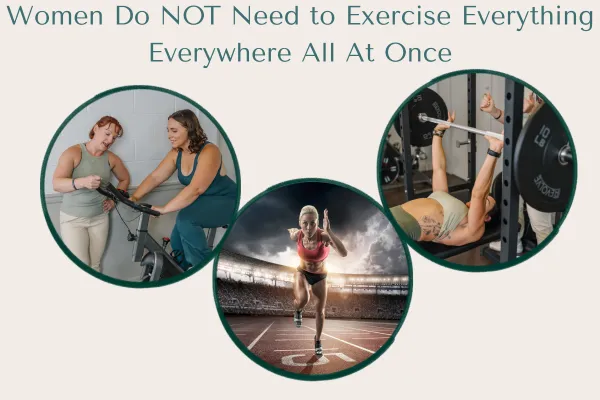
Women Do Not Need to Exercise Everything, Everywhere, All At Once
Can we talk about how absolutely insane the exercise advice for women has gotten?
Everywhere you look, someone has a different answer for how women should exercise. Lift heavy. Walk more. Do Zone 2. No, women need more high-intensity work. Don't do too much cardio because you'll lose muscle. Actually, cardio is essential for longevity. Train less. Train more. Recover more. Push harder.
No wonder women are confused, frustrated, and downright angry.
And here's the thing: I don't necessarily think all of this advice is contradictory. I think we're taking individual pieces of exercise physiology and trying to turn them into the answer.
But your body doesn't work that way.
If you've followed me for any length of time, you already know that I'm firmly in the "resistance training is king" camp. If I could convince every woman to do one thing differently, it would be to start lifting weights and get really, really good at being strong.
And there is a reason for that.
Muscle is one of the most important forms of physical reserve we can build. It supports strength, physical function, bone health, metabolic health, and independence as we age.
I’m tired of aging women being the frail, undernourished, underdeveloped victims of diet culture. I want them to be strong, independent, and kicking ass at 70, 80, and 90.
I want you to be able to pick up your grandkids. Carry your own suitcase AND put it in the overhead bin. I want you to be able to get yourself off the floor, carry groceries, move furniture, and catch yourself when you trip. I want you to keep hiking, traveling, skiing, playing, and doing whatever it is that makes your life yours.
So yes. Resistance training is king.
But it isn't the entire court.
This is where I think the conversation about exercise gets unnecessarily complicated. We talk about Zone 2, Zone 4, Zone 5, strength training, HIIT, cardio, conditioning, and metabolic training as though we have to choose one.
We don't.
Your body has more than one energy system
Your body has three primary energy systems, and they each play a different role. The phosphagen system provides quick, explosive energy for things like a heavy lift or a short sprint. The glycolytic system kicks in for harder efforts that last longer, like a HIIT interval or a challenging set of lifts. The oxidative system is your aerobic system, powering longer, steadier efforts like walking, hiking, or cycling. They all work together, but the harder and longer you work, the more you shift the demand between them.
They don't operate independently, and they don't take turns. They're all contributing to energy production all the time, but the contribution of each changes depending on the intensity and duration of what you're doing.
And that makes a lot of sense when you think about what we actually ask our bodies to do in real life.
You might spend an hour walking around the neighborhood. You might hike for three hours. You might carry a heavy suitcase through an airport. You might climb a few flights of stairs.
You might have to sprint across a parking lot because your kid is running toward the street. You might need to pick something heavy up off the floor.
Your body doesn't get to say, "Sorry, we're a Zone 2 household. We don't do sprinting."
Life requires all of it.
So I don't understand why our exercise programs would only train one piece of the system.
Yes, you need aerobic training
I love aerobic training.
Walking, hiking, cycling, rowing, swimming, steady-state cardio—there are a million ways to develop your aerobic system, and it is absolutely worth doing.
Building your aerobic capacity gives you the ability to sustain activity and helps you recover between harder efforts. It is a huge piece of the fitness puzzle, and I don't want women to overlook it just because they're focused on lifting weights.
We need to get out of this idea that Zone 4 is where it’s at or Zone 2 is the secret to longevity. Our heart rate zones are not nor should they ever be a religion. They are a part of human physiology and should be treated as an honored part of a whole system.
There isn't a magical point where your heart rate crosses a particular number and suddenly you've unlocked the secret to longevity. Your body is adapting to the demands you're putting on it across a spectrum of intensities.
And sometimes, I want you to go hard.
Really hard.
Not every day. Not even every workout. But I want you to periodically challenge the upper end of your cardiovascular system.
There is a reason we care about things like VO₂ max and cardiorespiratory fitness. As we age, our physical capacity declines. We don't get to maintain our highest level of fitness forever.
The goal is to build enough capacity now that we have a bigger reserve to draw from later.
That's one of the reasons I want women doing high-intensity work.
Not because suffering is good.
Not because every workout needs to leave you lying on the floor.
And definitely not because "more is better."
It's because your body adapts to the demands you place on it.
If you never ask your cardiovascular system to work near its upper limits, you're not giving it much reason to maintain that capacity.
And this is where I think Chris Hinshaw's approach to aerobic capacity makes so much sense to me. He talks about training all three energy systems instead of just one, or even two. All three. We have them for a reason.
That's the part I wish more women understood. We don’t have to pick a team. You don’t have to be the Zone 2 woman or the Zone 4 woman and you don’t have to be the “Cardi-No” weightlifting woman. In fact, you shouldn’t be.
Because we're not training for the workout. We're training for life. And life is unpredictable.
You don't know when you're going to need to carry something heavy. You don't know when you're going to have to move quickly. You don't know when you're going to spend an entire day on your feet.
You don't know when you're going to have to climb a mountain (ok, you usually do know that. That’s not usually a surprise), chase a toddler, carry luggage, or get yourself out of a situation quickly.
You want a body that has options.
That's the real goal of fitness for me.
I don't want women to spend their 40s obsessing over whether they got enough Zone 2 this week. I don't want them spending their 50s torn between being afraid of ending up an osteoporosis statistic or hurting themselves while lifting heavy. And I don't want them thinking that because they lifted weights three times this week, they don't need to challenge their cardiovascular system.
I want them to build muscle. I want them to develop their aerobic engine. I want them to periodically challenge their cardiovascular ceiling. I want them to maintain strength, power, balance, coordination, and the ability to move their bodies through the world.
Because here's the thing about aging: we're going to lose some capacity.
That's normal. It's part of being human.
But I want you to start with as much capacity as possible.
I want you to have enough muscle that you can afford to lose some and still be strong. I want you to have enough cardiovascular fitness that you can afford some decline and still have a capable heart and lungs. I want you to have enough strength and power that you can continue doing the things you love even as those qualities naturally become harder to maintain.
That's why I don't believe in the perfect workout.
I believe in building a body that can do a lot of things.
Resistance training is the foundation. Aerobic training builds the engine. Higher-intensity work keeps challenging the top end. And all of it works together to create something far more valuable than a good workout.
It creates capacity, and capacity gives you options. Twenty years from now, I don't care if you followed the perfect exercise prescription.
I care that you can still get off the floor.
I care that you can carry your suitcase.
I care that you can hike with your friends.
I care that you can pick up something heavy.
I care that you can move quickly when you need to.
I care that you have the physical capacity to keep participating in the life you built.
That's what we're training for.
Not the perfect workout.
A capable body.
So how do you actually train for all of it?
This is where I think exercise programming gets unnecessarily complicated.
You don't need six different workouts, seventeen exercises, and a spreadsheet tracking every possible adaptation. You need to figure out where the person is starting and then give her the appropriate next step.
First: Is your body ready to train?
This matters.
If someone is chronically ill, dealing with significant inflammation, struggling with an autoimmune condition, severely under-recovered, or otherwise not physiologically stable, throwing a hard exercise program at her may not be the answer.
Sometimes the first step in the health journey is getting the body to a place where it can actually tolerate training. That might mean addressing inflammation, nutrition, sleep, hormones, or whatever underlying issues are keeping her from being able to recover.
Exercise is a stressor. Even a good stressor is still a stressor.
So before we pile more stress onto the system, we need to ask whether the system is ready for it.
Second: Is she stable?
Can she control her body? Can she maintain balance? Can she move through basic positions without pain or instability? If she can't, we're not loading a barbell and hoping for the best. We work on stability first. Once she demonstrates the stability necessary to move safely, we can start introducing movement.
Third: Can she perform the fundamental movement patterns?
Can she hinge? Squat? Lunge? Rotate? Push? Pull?
If she can execute those patterns well, great. Now we have something we can progressively overload. If she can't, that's not a failure. That's our starting point. We train the movement pattern until she can perform it well enough to progress.
And this is where I think exercise programming becomes beautifully simple.
Once you have the foundation, pick your movements and stick with them long enough to actually get better.
We're not changing exercises every week because we're bored. We're not constantly chasing the newest workout.
We're going to spend roughly 8–12 weeks in a muscle-building phase, followed by 8–12 weeks in a strength phase. With the same movements.
There are multiple reasons for this.
The hypertrophy, or muscle-building, phase generally uses higher repetitions, which means more practice.More reps means more opportunities to learn the movement, refine technique, build confidence, and get really good at the exercise.
Then, after the client has had a lot of practice and is feeling confident with the movement, we want to make her strong.
Strength work generally uses lower repetitions and allows us to use heavier loads. There is less room for movement faults when the load gets heavier which is why we want her to be a movement pro before training for strength.
I want the movement to be dialed in before we start asking the body to produce more force.
That's 16–24 weeks of progressively training the same fundamental movements and getting stronger at them.
Then we change the program.
Not because the old exercises suddenly stopped working but because you've spent enough time adapting to them that we're ready to give your body a new challenge.
And as the athlete becomes more advanced, we can begin layering in power work.
Now we're not just asking, "How much force can you produce?" We're asking, "How quickly can you produce it?" Suddenly, we're back to the bigger picture.
We're training the whole system.
But we're not trying to train everything everywhere all at once.
We're building capacity in layers.
Assess. Stabilize. Learn to move. Build muscle. Build strength. Develop power.
Simple.
Not easy.
But simple.
And that's really the point.
You don't need a more complicated workout. You need a better progression.
And what about cardio?
We work it in.
This is where I think the whole thing gets much simpler than the internet makes it seem.
You don't need a separate "cardio phase" where you stop lifting weights. And you don't need to spend six days a week trying to hit every possible training adaptation.
Instead, I like combining a resistance training component with a conditioning component within the same training block.
The conditioning piece might be metabolic conditioning, often using intervals or HIIT. So you might lift and then finish with a short conditioning piece that challenges the glycolytic and phosphogen systems.
Then, in another block, we might keep the lifting and replace some of that high-intensity conditioning with steady-state work that strengthens the aerobic system.
Or, if someone is training three days a week, we might do two days of lifting plus HIIT and one day of lifting plus steady-state cardio.
The exact combination depends on the person.
How much time do they have?
What is their current fitness level?
How well do they recover?
What are we trying to improve?
What can their body tolerate right now?
Those questions matter much more than whether someone on Instagram told you that women must do Zone 2 four days a week or that HIIT is the secret to women's longevity.
And this is where I think the idea of "Everything Everywhere All at Once" really takes off in relation to women’s fitness.
Yes, we want to train all of it.
We just don't have to train all of it at the same time, at the same intensity, or in the same proportion.
That's the elegant part.
We can build the program around the person in front of us, prioritize what she needs most, maintain what we've already built, and then shift the emphasis when she's ready.
We're not choosing between strength and cardio.
We're not choosing between Zone 2 and Zone 4.
We're building a body that can do all of those things.
Just not everything everywhere all at once.
Ready to stop guessing?
You don't need another Instagram workout telling you what you should be doing.
You need someone to look at where you are right now, figure out what your body is ready for, and build from there.
That's exactly what we do at Evolved Women's Health.
Our personal training isn't about throwing you into a room and handing you a generic workout. We assess where you're starting, identify what needs attention, and build your training progressively so you can become stronger, fitter, and more capable without trying to do everything everywhere all at once.
If you're ready for a training program that actually makes sense for your body, book a discovery call with us at evolvedwomenshealth.com.
Let's figure out where you are, where you want to go, and what it will take to get you there.
