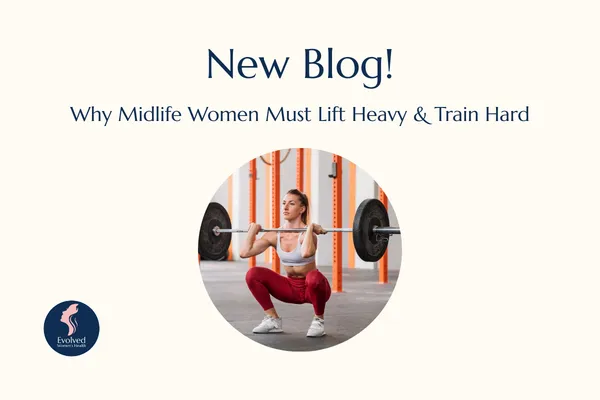
Why Midlife Women Must Lift Heavy and Train Hard
Introduction
There is a quiet lie many women have been living inside of for decades.
We were told that if we just stay active, take a few classes a week, sweat a little, and keep moving, we would age well. For a while, maybe it was. But midlife changes the rules.
During perimenopause and menopause, estrogen shifts affect muscle mass, bone density, fat distribution, and insulin sensitivity. The North American Menopause Society makes it clear that muscle and bone loss accelerate during this phase of life. The American College of Sports Medicine and the National Strength and Conditioning Association are equally clear: maintaining and building muscle requires progressive resistance training.
Midlife requires a new strategy.
If your workout never asks you to strain, brace, push hard, or recover breathlessly, it is not building the kind of body that resists aging.
Group fitness classes, especially steady-state dance fitness formats and cardio-based classes, are not bad. They are energizing. They are social. They are far better than sitting on the couch. But they are not strength training. They are usually not sufficient, by themselves, to combat sarcopenia, osteoporosis, and metabolic decline long term.
Muscle Is Metabolic Currency
After age 30, adults begin losing muscle mass gradually, and the rate accelerates with age. This age-related muscle loss, known as sarcopenia, is not cosmetic. It is metabolic.
Muscle acts like a sponge for blood sugar. When you eat carbohydrates, they break down into glucose in your bloodstream. Your body must move that glucose into your cells. Muscle tissue is one of the primary places that glucose is stored and used.
The more muscle you have, the bigger the sponge. When muscle decreases, the sponge shrinks.
This is when many midlife women begin saying:
“I haven’t changed anything. I’m eating the same. Why am I gaining weight?”
The solution is not extreme dieting. Chronic caloric restriction without resistance training often leads to further muscle loss, fatigue, and metabolic slowdown. Shrinking your intake without building tissue only makes the sponge smaller.
Resistance training builds the sponge. High-intensity intervals make those muscles even better at soaking up glucose. The American College of Sports Medicine recommends resistance training at least two days per week for all adults. The National Strength and Conditioning Association further clarifies that building strength and muscle requires progressive overload, meaning the weight must challenge you. The last few repetitions should feel hard.
This is not about being smaller. It is about being stronger.
Let’s Talk About Intensity
Somewhere along the way, women in midlife were told to avoid intensity to protect their hormones.
Slow it down. Keep it gentle. Just walk. Just do yoga.
Walking is excellent. Yoga is powerful. Pilates builds control and mobility. But they are not the entire strategy.
The American College of Sports Medicine recommends that adults accumulate approximately 75 minutes per week of vigorous-intensity aerobic activity. Vigorous intensity means working at about a 7 to 10 out of 10 effort.
Rate of Perceived Exertion, or RPE, is a simple way to measure effort:
3 to 4: You can easily talk.
5 to 6: You are breathing harder but can hold a conversation.
7 to 8: Talking in full sentences is difficult.
9 to 10: You can barely speak.
Vigorous intensity lives in that 7 to 10 range. If you can comfortably chat through your entire workout, you are likely not reaching vigorous intensity.
You do not need 75 minutes all at once. You might accumulate it through short intervals three times per week. But over the course of a week, you should be spending meaningful time where talking feels hard.
Your heart is a muscle. If you never challenge it, it will not stay powerful.
What HIIT Actually Looks Like
High-Intensity Interval Training, or HIIT, has become a buzzword. But true HIIT is not just fast choreography or constant movement for 45 minutes.
Proper HIIT has structure. You work very hard for a short burst. Then you rest. Then you repeat.
For example:
30 seconds of as many burpees as you can.
90 seconds of rest.
Repeat several times.
During the work portion, you should feel breathless and focused. Your muscles may burn. You may feel slightly uncomfortable but still in control.
During the rest portion, your heart rate comes down enough that you can go hard again.
If there is no real rest built in, it is not true interval training. If you can talk the whole time, it is not high intensity. If there is no measurable progression over time, it is not progressive.
Intensity must be intentional and repeatable to drive adaptation.
Hormones Are Adaptive, Not Fragile
There is a common fear that high-intensity exercise will disrupt hormones in midlife women.
Unmanaged chronic stress is harmful. Sleep deprivation and under-eating are harmful. Structured, time-limited high-intensity training with proper recovery is not the same thing. Hormones respond to stimulus.
Resistance training supports muscle mass, which improves glucose control and insulin sensitivity. Vigorous interval training improves cardiovascular capacity. Both are protective during menopause.
The Institute for Functional Medicine emphasizes metabolic resilience. That resilience requires tissue, strength, and capacity. You cannot supplement your way out of muscle loss. You must load it.
Bone Density and the Need for Load
Bone is living tissue. It responds to force.
The National Osteoporosis Foundation recommends weight-bearing and muscle-strengthening exercise to prevent bone loss. Walking is weight-bearing, but it produces relatively low force. Heavier lifting, jumping, sprinting, and loaded movements create greater mechanical strain on bone. That strain signals bone to stay dense.
We cannot out-supplement osteoporosis. We must out-load it.
We Need to Talk About Group Fitness
Dance-based cardio classes and steady-state group fitness formats are fun. They are social. They improve mood and consistency.
But if the weights are light and never increase, if you can comfortably talk most of the time, and if your body has not measurably changed in years, that class is maintaining you at best.
Maintenance is not enough in midlife. The hormonal environment is shifting. Muscle protein synthesis becomes less responsive. Bone turnover accelerates.
If biology is moving in one direction, standing still will not keep you in place. You have to row. Harder than you used to.
This does not mean you quit your favorite class. It means you stop pretending it is the whole plan.
The Progression Ladder
This is not all or nothing.
If you are walking, keep walking. Add hills. Add short bursts where talking becomes difficult.
If you are jogging, add structured intervals.
If you are using light dumbbells, gradually increase the weight. Strength requires progressive overload. The weight must challenge you.
If you love group fitness, keep the community and joy. But add two dedicated strength sessions per week with challenging loads.
You do not abandon where you are. You build from it. Midlife requires a new strategy, not a personality transplant.
Build, Don’t Shrink
This is not about being smaller. It is about being harder to break.
Women who lift heavy and train at high intensity, intelligently and progressively, are building muscle, preserving bone, improving metabolic health, and increasing capacity.
You deserve more than maintenance. You deserve strength. You deserve resilience. You deserve a body that can carry you confidently through the second half of your life.
If you are ready to train differently, seek out structured strength programming, a qualified coach who understands menopause, or a performance-based training environment such as CrossFit. You can also work with us directly while our limited personal training spots are available. If our schedules do not align, we are happy to refer you to trusted professionals, including The Durable Human Gym in Springville.
Midlife requires a new strategy. Let’s build it.
References
American College of Sports Medicine. ACSM’s Guidelines for Exercise Testing and Prescription.
National Strength and Conditioning Association. Resistance training and hypertrophy position statements.
North American Menopause Society. Clinical guidance on menopause and musculoskeletal health.
National Osteoporosis Foundation. Exercise recommendations for bone health.
Institute for Functional Medicine. Frameworks for metabolic resilience.
CrossFit. Foundational methodology defining intensity and measurable output.
