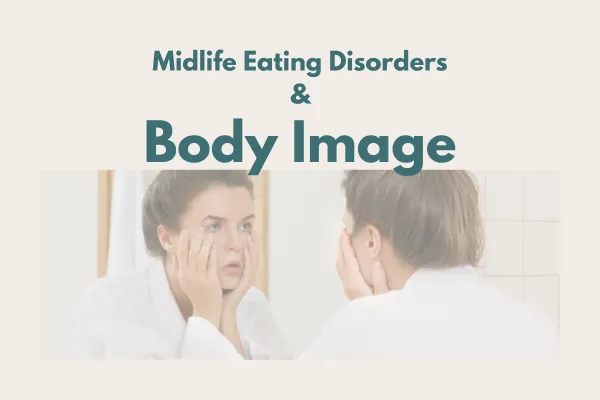
Midlife Eating Disorders & Body Image in Women 40–60Post
When Eating Disorders Don’t Look Like Eating Disorders Anymore
There’s a version of eating disorders most people still picture.
It’s young. It’s visible. It’s extreme.
And because of that, a lot of women in their 40s and 50s quietly rule themselves out of the conversation entirely.
Because what they’re dealing with doesn’t “look like that.”
But here’s the truth most people miss:
Eating disorders don’t expire when you turn 25.
They evolve. They adapt. They hide in plain sight.
And midlife—especially perimenopause—is often when those patterns stop staying quiet.
Not because something suddenly goes wrong.
But because the body stops cooperating with strategies that used to work.
Midlife Is Not a Neutral Season for the Body
Perimenopause is not subtle.
Hormones shift. Sleep changes. Recovery slows. Stress tolerance drops. Appetite regulation changes.
And the body you’ve known for decades starts responding differently—sometimes unpredictably.
So what do most high-achieving women do?
They try to regain control.
Not out of vanity.
Out of familiarity.
Because control has worked before.
Control of food.
Control of exercise.
Control of structure.
But here’s the uncomfortable truth:
What used to feel like discipline in your 20s can become rigidity in your 40s and 50s.
And nobody really prepares women for that transition.
Negative Body Image Issues Don’t Disappear—They Intensify
We all have a body image. That’s normal.
The issue is negative body image issues—the kind that create distress, shame, and behavioral compensation.
And in midlife, those often don’t get quieter.
They get more entrenched.
Instead of disappearing, they evolve into things like:
constant body checking
obsessive comparison to a younger self
anxiety about clothing, photos, or visibility
belief that body changes equal failure
“fixing” the body as a life project
Culturally, we don’t help this.
We’ve taught women that:
thinness equals health
control equals discipline
aging equals decline
So when the body changes, many women don’t interpret it as biology.
They interpret it as failure.
The New Face of Eating Disorders in High-Functioning Women
In reality, eating disorders in midlife rarely look dramatic.
They look like:
“I just need to get back to my 20s body”
“I was healthier when I was stricter”
“I just need to be more consistent again”
Increasingly rigid “healthy eating” patterns
Exercise that shifts from supportive to compulsory
Frustration toward a body that won’t “respond anymore”
And here’s the part most women don’t realize:
They don’t think they have an eating disorder.
They think they’re trying to be healthy.
But underneath is often something deeper:
A long-standing relationship with control, identity, and worth that food and body behaviors have been quietly organizing for decades.
Where Eating Disorders Actually Live
Eating disorders are not really about food.
Food is just the behavior.
Underneath it is usually:
nervous system dysregulation
chronic stress
perfectionism
emotional avoidance
identity control strategies
unresolved internal pressure
Which is why nutrition-only solutions so often fall short in complex, long-standing cases.
Because you can’t out-plan a regulation issue.
Why Nutrition and Fitness Coaching Matter (When Done Right)
Let’s be honest—nutrition and fitness coaching get misunderstood in this space.
They are not the problem.
But they can become part of the problem when they reinforce:
restriction
punishment
rigid control
identity tied to compliance
In integrated care, they function very differently.
They help:
restore metabolic stability
rebuild trust with hunger and fullness cues
regulate stress physiology
reintroduce movement that supports, not drains, the system
For many women in midlife, the issue is not lack of effort.
It’s that effort has been misdirected for years.
This Is Where Integrated Care Changes Everything
At Evolved Women’s Health, in collaboration with our sister psychiatry practice The Journey Within, we treat this as a systems issue—not a willpower issue.
Because eating behaviors are shaped by:
hormones
metabolism
nervous system regulation
emotional patterns
identity and stress history
So care has to reflect that complexity.
Our approach integrates:
functional and medical evaluation
nutrition and metabolic support
fitness coaching focused on regulation
psychiatric care when needed
therapeutic work addressing identity, control, and emotional patterns
When those systems finally communicate, something shifts.
Not overnight.
But meaningfully.
The internal fight starts to quiet.
The Women We See Most Often
The women we see most often are not confused about nutrition.
They are highly capable, educated, and often very disciplined.
They just don’t understand why their body won’t respond the way it used to.
They usually say things like:
“I don’t get it. I’m doing everything I used to do in my 20s.”
They often return to what once worked:
stricter eating
cleaner eating
more structured exercise
more control
Sometimes it looks like a “healthy diet” that gradually becomes more restrictive over time.
And when the body still doesn’t respond the way it used to, frustration builds.
So they try harder.
But the harder they try, the worse they often feel:
more fatigue
more body frustration
more rigidity
less metabolic resilience
And slowly, they start to realize something is off—but can’t quite name it.
What Actually Changes Things
Not more discipline.
Not more restriction.
Not more control.
What changes things is understanding the system underneath the behavior.
So instead of asking:
How do I get my body back?
We start asking:
What is my body responding to right now?
What systems are out of alignment?
What has this pattern helped me manage emotionally or physiologically?
And what would regulation actually look like?
That’s where real change starts.
Not because the body is forced into compliance.
But because the system finally gets support instead of pressure.
A Different Kind of Care for Midlife Women
If you’ve been stuck in cycles of:
trying harder
feeling worse
and wondering why nothing works the way it used to
You’re not alone in that experience.
And more importantly, you’re not dealing with a lack of discipline.
You’re likely dealing with a system that has been over-managed for years and is now asking for a different approach.
Not less care.
Just better-aligned care.
Ready to Work With Us?
At Evolved Women’s Health, we help women in midlife untangle the complex relationship between:
food
body image
hormones
metabolism
and identity
Through a fully integrated model that combines medical, nutritional, fitness, and mental health support.
If you’re ready to stop cycling through approaches that don’t hold long-term—and finally understand what your body is actually asking for—we’d love to work with you.
👉 Book a discovery call with our team at:
https://evolvedwomenshealth.com/discovery-call
Because your body isn’t failing you.
It’s responding to a system.
And once that system is supported correctly, everything changes.
